
Exoplanetas»Descubriendo impactos de asteroides con Google Earth
Descubriendo impactos de asteroides con Google Earth
Publicado por Emilio González | 08/01/2025Lo que se narra a continuación es la historia del descubrimiento de dos estructuras candidatas a impactos de asteorides descubiertas en 2006 utilizando Google Earth . El artículo original se perdió con la reestructuración de la web, así que se trata de una reedición.
En este artículo encontrarán la historia paso a paso del descubrimiento de dos cráteres candidatos a ser el resultado del impacto de asteroides contra nuestro planeta, y como además pueden ayudar a verificar una teoría de una geóloga de la NASA.
El 6 de Marzo anunciamos el descubrimiento de un cráter de impacto en Kebira, Egipto, cerca de la frontera con Libia, de 31 km de diámetro por parte de investigadores de la Universidad de Boston.
EL día 8, utilizando el programa Google Earth decidí comprobar como se vería este cráter, pues las imágenes por satélite que ofrece este programa varían en calidad de un lugar a otro. Lo lógico habría sido pensar que su figura sería difícil de distinguir y que por ello no había sido descubierto hasta el momento, pero siguiendo la descripción del artículo me dirigí a la frontera entre Egipto y Siria, y en menos de un minuto localicé perfectamente la figura del cráter.
El cráter Kebira desde 30 km de altura
La pregunta que surgió de inmediato fue ¿Y nadie se había dado cuenta antes? ¿Cómo puede una estructura como esa, de 31 kilómetros, pasar desapercibida? Así que me propuse explorar un poco los alrededores por si hubiera otras estructuras similares.
Justo había pasado ya Libia y entraba en Chad cuando desde una altura de 121 millas otra estructura claramente circular apareció en mi pantalla. Una vista más cercana mostraba una estructura aparentemente típica de un impacto, no volcánica. Localizar un cráter de impacto no tenía ningún mérito si este ya era conocido, así que debía comprobarlo y visité la lista de cráteres de impactos de la Universidad de Brunswick, en Canadá, sin que coincidiera con ninguno de los conocidos.
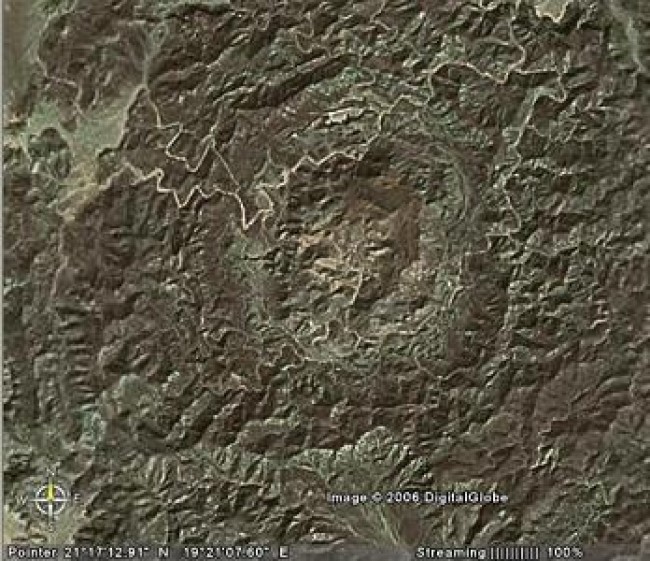
El primer cráter visto desde 20km de altura
Decidí volver a las alturas y en pocos segundos una mancha sospechosa a apenas 50km de distancia del cráter anterior llamó mi atención. Me acerqué y enseguida me di cuenta de que a primera vista las características coincidían nuevamente con las de un cráter de impacto. Este cráter tampoco figuraba en la lista de la Universidad de Brunswick. No podía ser tan fácil. ¿No estaría sufriendo un estado de excitación que me haría ver cráteres de impacto por todas partes?
Busqué más información en Internet, encontrando otra web http://www.impact-structures.com dirigida por dos geólogos, Kord Ernston de la Universidad de Würzsburg y el español Fernando Claudín, del Museo de Geología de Barcelona, y enlazaban con una base de datos más actualizada que la canadiense y envié las imágenes en espera de algún comentario.
La respuesta de Fernando Claudín fue casi inmediata. Según el geólogo "la circularidad por si sola no es un criterio que baste para identificar una estructura como de impacto", si bien en el primer cráter observa "un anillo externo cuyas capas parecen inclinadas hacia el exterior (buzamiento radial a partir del centro de la estructura), y un anillo interno o levantamiento central" Y finalmente concluye "No me parece una estructura volcánica"
Respecto al segundo cráter comenta que "menos marcado que el anterior, también me parece apreciar dos anillos, uno externo y uno interno, en este caso surcados por caminos (lo que en principio es bueno ya que significa, a priori, afloramientos). La zona central parece deprimida (delimitada por el anillo interno)"
El problema para realizar la confirmación es básicamente económico: Es necesario que acudan los geólogos al lugar para comprobar si existen "brechas, diques de brechas, conos astillados, metamorfismo de impacto, etc."
El segundo cráter desde unos 5000 metros de altura
Lo mejor para mi estabilidad emocional fue sin duda que según Claudín "no parece que estés afectado por la fiebre de impactos. Hay base más que suficiente para empezar a investigar".
Así pues tenemos dos cráteres que, tienen todo el aspecto de haber sido causados por impactos de asteroides, pero necesitan de una visita para obtener la confirmación.
Estaban bastante cerca el uno del otro
Debía de haber un error en alguna parte. A pesar de todas las precauciones que había tomado no podía creerme que yo hubiera sido el primero en ver esas dos estructuras tan claras, así que quisé localizar más información sobre cráteres de impacto en Chad. Tras poner las palabras -en inglés- en el buscador aparecía el cráter de Aorounga, un cráter que naturalmente figuraba en las bases de datos que había consultado. Lo curioso fue que encontré un artículo sobre Adriana Ocampo, una investigadora del JPL de la NASA que mediante imágenes de radar había detectado varios impactos más junto a Aorounga, que era necesario confirmar. ¿Sería posible que mis cráteres formaran parte de esa cadena? Nuevamente abrí el programa me dirigí a Aorounga y elevé la vista lo suficiente como para que todos los cráteres aparecieran en la pantalla, pues hay 300km de distancia entre ellos ... y ¡ Todos estaban en línea!
Dejé pasar un tiempo esperando más confirmaciones. No quería publicar algo que después resultara un fiasco. Pero los canadienses no respondían a mis mensajes. Fernando Claudín quería que Kord Ernstson también diera también su opinión, así que esperé (im)pacientemente hasta que su opinión llegó "¡ Felicidades ! Las estructuras que has descubierto son muy prometedoras!". Según Kord "el que haya dos cráteres más en la línea de Aorounga es fantástico", algo parecido al la línea de impactos que están estudiando en Azuara, entre Teruel y Zaragoza.
Finalmente recibí un email de Jason Hines, Data Manager de la Base de Datos de Estructuras de Impacto de la Universidad de Brunswick. "Parece que has encontrado unas estructura de impacto candidatas", dice, pero insiste "tomar muestras del lugar de indicios de impacto es el mejor método de confirmar el origen de un impacto".
La historia continúa. En estos momentos sigo esperando respuestas de los canadienses, de David Morrison (reponsable de la web de la NASA http://impact.arc.nasa.gov) y de Adriana Ocampo, a quien el descubrimiento de estos cráteres podría ayudar a confirmar su teoría si todos los cráteres tuvieran la misma datación.
Lo más importante de esta historia probablemente sea el que gracias a un software de distribución gratuita es posible para cualquiera realizar una búsqueda de estructuras semejantes. Probablemente tuve suerte, ya que después de este éxito inicial he pasado horas recorriendo África sin resultado.
De cualquier forma, si se decide a buscar cráteres de impacto, asegúrese de no confundirlos con volcanes, compruebe las listas de impactos ya conocidos, o posibles candidatos y entonces, sólo entonces: ¡consulte con su geólogo!
Buena caza.
En Junio de 2006 fuimos invitados a participar en un simposio de impactos de asteroides que tenía lugar en Ostersund, Suecia, a donde acudimos dos representantes de Astroseti, yo mismo y Sergio Alonso.
Obtuvimos una imagen de satélite original con una resolución extraordinaria del segundo de los cráteres, y Sergio desarrollo un programa para poder 'navegar' y agrandar partes concretas, así como poder ver la imágen con distintos filtros para poder apreciar más detalles.
Ostersund, tan al norte que el Sol en esa época no se ponía con lo que gozábamos de 24h de luz, es una localidad interesante respecto a los impactos de asteroides, ya que hay evidencias de que allí mismo se produjo un impacto hace millones de años.
Realizamos una 'poster presentation', explicanndo el descubrimiento, y la flor y nata de los científicos expertos en la materia pudo examinar las imágenes y debatir con nosotros
Hay que decir que de los comentarios de los científicos surgieron básicamente 3 posturas.
1) Se conocen ya muchas estructuras candidatas (entonces unas 200), y en lugar de añadir más hay que concentrarse en las que tenemos y confirmarlas
2) Podría tratarse de estructuras volcánicas
3) Hay indicios clarísimos de que podría tratarse de estructura de impactos, pero sería necesario ir allí a confirmarlo
Respecto a la primera, en mi opinión es lo más triste que podía decirnos un científico (en este caso es una "estrella" de los medios en este caso). No niega que sea una estructura, sino que simplemente no importa porque ya conoce otras. Y sobretodo me entristece porque como apuntamos no se trata de una estructura más, sino que podría ser la confirmación de la primera cadena de impacto en nuestro planeta.
Respecto a la segunda, realmente nos encontramos en una zona volcánica, pero nadie nos pudo responder porqué serían los únicos dos volcanes erosionados mientras a su alrededor hay volcanes comi el Emi Koussi de 3500m de altura. sin erosión.
Y me quedo con la opión de Jay Melosh, uno de los mayores expertos mundiales. Cuando le comenté que nos decían que la zona era volcánica dijo : "Los asteroides no eligen donde caer, también caen en zonas volcánicas".
Jay Melosh nos animó a confirmar experimentalmente que se trataba de impactos, e hicimos algunos contactos con geólogos que habían trabajado en la zona para ver si sería posible estudiarlos, pero la situación política inestable llevó el descubrimiento al cajón.
De momento los dos cráteres figuran en las listas de estructuras candidatas, y quizás algún día se confirme el descubrimiento que desde Astroseti, desde una pantalla de ordenador con Google Earth, se hizo de dos impactos a miles de kilómetros
- Twittear


- » ExTrA. Tránsitos en torno a enanas rojasPor Raul | 3 comentarios
- » Viajes a MartePor pochimax | 253 comentarios
- » ¿Estudiar biología (casi) sin matar animales? O me acostumbrPor Angelus_86 | 6 comentarios
- » SpaceX presenta un potente cohete capaz de llegar a MartePor pochimax | 51 comentarios
- » Estrellas gigantes con planetas (y comilonas)Por pochimax | 19 comentarios
- » LA TEORÍA DE LAPLACE PODRÍA NO SER CORRECTAPor pochimax | 9 comentarios
- » Aurora y la imposibilidad del viaje interestelarPor pochimax | 0 comentarios
- » Plutón - New HorizonsPor pochimax | 33 comentarios
- » Saturno 19-06-15Por Paco Yepes | 2 comentarios
- » HD189733b El planeta del aguaPor pochimax | 3 comentarios
Comentarios